
Our Terragrout System
We haven't figured out how to turn water into wine, however we've gotten pretty good at turning sandy soil into rock... Welcome to Terragrout.
Long-Term Applications of Sodium Silicate Soil Grouting
One of the primary long-term applications of sodium silicate grouting is groundwater control. The grout permeates granular soils, filling the interconnected voids between soil particles and creating a low-permeability barrier that helps reduce or eliminate water migration. This makes it an effective solution for sealing leaking structures, controlling seepage beneath foundations, and preventing groundwater intrusion into below-grade facilities.
Sodium silicate permanently strengthens loose sands and gravels by bonding soil particles together. The treated soil exhibits increased shear strength and improved stability, making it suitable for supporting structures, reducing settlement, and preparing weak ground for construction.
In conjunction with underpinning systems such as micropiles and helical piles, sodium silicate grouting can improve surrounding soil conditions, reduce localized movement, and enhance overall foundation performance. It is particularly valuable where unstable granular soils contribute to settlement.
Contractors frequently use sodium silicate grouting to stabilize soils around deep excavations, shafts, tunnels, and utility trenches. The treated ground resists running sands and groundwater inflow, creating safer excavation conditions while minimizing the risk of adjacent settlement.
The grout is widely used to stabilize soils surrounding existing tunnels, pipelines, and underground utilities. By reducing water infiltration and strengthening surrounding soils, sodium silicate helps protect aging infrastructure and extend its service life.
Where voids or loose granular soils exist beneath slabs, pavements, or structures, sodium silicate grout can permeate the soil and improve its density and strength. This helps reduce future settlement and restores support to overlying structures.
Because sodium silicate is inorganic and does not introduce petroleum-based compounds into the soil, it has been used on environmentally sensitive projects where groundwater protection is an important consideration. Proper mix design and installation are essential to ensure the grout performs as intended.
Advantages of Sodium Silicate Grouting
- Permanently reduces soil permeability in suitable granular soils.
- Increases soil strength without major excavation.
- Penetrates fine sands that are difficult to stabilize using cement-based grouts.
- Causes minimal vibration or disturbance to adjacent structures.
- Can be installed in confined spaces and beneath existing buildings.
- Complements underpinning systems such as micropiles and helical piles.
- Cost-effective compared to extensive excavation and replacement.
Long-Term Performance
Restoring Lost Ground Density with TerraGrout® Sodium Silicate Soil Grouting
Restoring the Ground Beneath Existing Structures
How TerraGrout Works
Engineering Benefits
- Restores soil density within minutes.
- Fills voids created by erosion, piping, or utility failures.
- Increases the soil’s resistance to future particle migration.
- Improves bearing capacity and reduces compressibility.
- Stabilizes loose, saturated, or water-bearing sands.
- Reduces the risk of continued settlement beneath existing structures.
- Can be installed beneath occupied buildings with minimal disruption.
- Maintains structural support while avoiding costly demolition and reconstruction.
- Environmentally responsible when properly designed and installed.
Typical Causes of Density Loss
- Broken water mains
- Leaking sanitary sewer systems
- Stormwater pipe failures
- Utility trench settlement
- Groundwater erosion
- Sinkhole activity
- Repeated flooding
- Poorly compacted backfill
- Long-term migration of fine sands
- Decomposition of buried organic materials
Applications
- Existing building foundations
- Industrial facilities
- Warehouses
- Bridge approaches
- Airport pavements
- Highway embankments
- Utility corridors
- Concrete slabs
- Retaining structures
- Marine facilities
- Port infrastructure
Why Engineers Specify TerraGrout
Projects
How To create a basement level elevator stop in an existing building where there is no basement level, was the challenge presented to Dosdourian Enterprises, Inc.
The Challenge
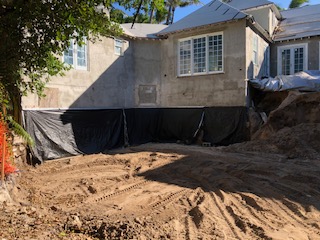
An oceanfront 3 story home built around mid-century was going through a major structural and architectural rehabilitation. The owner had commissioned the Engineer, Mr. Chris Pruitt from the Pruitt Design Group to design an elevated pool deck on the exterior of the house with storage underneath the pool deck. The owner wanted access to the storage area by means of a new elevator stop below the 1 st floor level which was nonexistent. The challenges we had to overcome was to create a sublevel environment for a new sub-grade elevator stop and a tunnel to access the new storage area under a new structural pool deck on grade supported building.
The Solution
The Structural Engineer, Mr. Chris Pruitt, President of the Pruitt Design Group assembled a team who have worked together previously consisting of Wendell Rogers, the Geotechnical Engineer from Allterra Engineering and Bryan Pollock and Sam Dosdourian from Dosdourian Enterprises, Inc to develop a conservative approach to the challenge outlined above. The approach mutually decided upon was to structurally underpin the rear elevation of the grade supported 3 story building that was adjacent to the new structural pool deck and to enhance the soil with Dosdourian’s patented chemical grouting system called TerraGrout. The Helical Underpinning piles were designed to carry the gravity load of the 3 story building and the TerraGrout turned the sand fines into sandstone to prevent soil from sloughing out from under the structure. The next challenge was to create the tunnel underneath the building by underpinning the structure with driven pin piles and custom fabricated underpinning brackets attached to footings which were in close proximity to the area of the tunnel. The next step was to create the environment for the tunnel excavation. TerraGrout was utilized to solidify the sand fines on both sides of the new tunnel to prevent soil slough. At the end of the day, the General Contractor was able to dig vertically directly under the footings along the interface of the new structural pool deck, form and pour a new footing 9’ below the existing footings and extend the building wall. The next step was to excavate the soil treated with TerraGrout and dig out the new tunnel. The General Contractor attached the waterproofing directly to the TerraGrout and also utilized the TerraGrout for the rear form.
Problem Solved
This was a very challenging project with a lot of moving pieces. Which turned the Owners Dream into a reality.